There's a statistic out there that says the number one cause of death for wildlife biologists is aviation accidents (66% percent, in fact); thus you can understand my hatred of planes (and now helicopters too). I don't have access to the entire journal article, but I would guess some of the other contenders might include contracting wildlife diseases*, firearms accidents, falls, and the like.
Who would guess that something so innocent as radio telemetry might endanger a biologist's life? Yes, radio telemetry, that so-common activity of standing with a metal antenna in your hand and swinging it in a circle until the radio signal is the loudest. Radio telemetry has long been, and continues to be, the best way to locate a tagged animal in the field in real-time. I can't tell you how many animals I've tracked, how many different types of receivers and antennae I've used, or how many nightmares I've had to the rhythm of the beep-beep-beep of an animal's collar in my head.
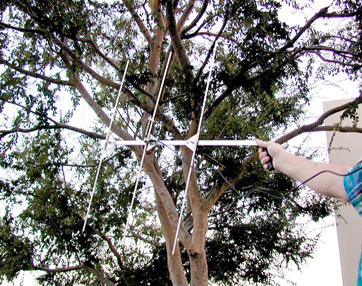 I should preface this story with a tale of a friend of mine from college who was in the Idaho wilderness tracking rattlesnakes tagged with radio transmitters. He was using a Yagi antenna, the most common of which look something like the picture on the right, made up of three thin metal "elements" or crossbars. Now, this fellow was rather enthusiastic about his work, and I can imagine him frolicking down a rock-strewn hillside searching for one of his snakes, not paying as much attention to his footing as he should. And sure enough, he tripped and fell and landed right on that Yagi. One of the elements evidently slipped over his eyeball and poked right through his orbital bone into his brain. Sounds icky, I know. Luckily, however, he was able to get back to the ranch and catch the next plane to Boise to go to the hospital, and got out the next day with just some swelling, headaches, and a forced vacation.
So, we've established one of the dangers of radio telemetry. The other one is perhaps more obvious:
When one works outside, one may occasionally get caught in a thunderstorm. And when this happens, one does not want to be holding up a metal antenna.
In 2011, I returned to the Black Hills for a different project involving woodpeckers, this time with Black-backed woodpeckers (abbreviated BBWO for all you bird nerds). It was an entirely different project with an entirely different supervisor, but oddly enough, many of the study areas were the same. Thus, I frequently found myself returning to Wind Cave National Park to the very area where I almost ran into a sleeping bison and got almost eaten by a mountain lion (or so I thought) in 2005.
If you recall that last reference, one of the things that freaked me out on that trip was the looming threat of a thunderstorm. You really don't want to mess with thunderstorms out there, because there are few places to hide and generally we're carrying lots of expensive field equipment (GPS units and digital telemetry receivers, to name a few). But in that particular instance the storm dissipated before it got to me. That happens a lot with the summer monsoons.
In 2011, I parked at the Wind Cave campground to track a male woodpecker for a foraging observation. I didn't take a GPS waypoint at my truck, since I knew the area pretty well and it really wasn't that big a place. It would be nearly impossible to get lost. Plus I pride myself in my excellent inner compass, something which has come in handy many a time.
 |
| a male BBWO |
On this particular day, that's what the bird did. It started out not too far from the campground, and so I didn't take any food or water or other supplies, just my binoculars, GPS unit, and telemetry equipment. Soon, though, the short hike began to turn into a merry chase. What was supposed to be a ten-minute observation started taking upwards of an hour. I had seen when I first set out that a rather ominous-looking thunderstorm was looming close to the west, but typically these storms moved south and I didn't expect it to hit me. I also remembered all those times the storm threatened but never actually hit, and I was bound and determined to finish this bird's fricking observation. It had gotten personal. That damn bird was NOT going to thwart me.
It did anyway. I had to call it quits after getting only eight or nine minutes of observation, as the thunder was cracking louder and big fat raindrops were beginning to fall. You can hear the lightning through the telemetry receiver, too, which is really freaky - you might not see the flash or hear the thunder right away, but the receiver picks up the electricity and sends out a loud and startling burst of static. Anyway, I thought I knew where I was, maybe a mile as the crow flies from where I had parked my truck at the Wind Cave campground. By this time I knew that the storm was going to hit - there was no doubt about it anymore - but I hoped that, if I hurried, I might make it back to the truck before it got really bad.
It's really difficult to explain the topography there, even with the help of a map. But the land was folded in lots of little ridges that went every which way from a broader plateau, eventually leveling out into the flatter plains of the park where the grasses waved and the bison roamed in their huge herds. I had followed the woodpecker up one of the northern ridges and continued climbing more gradually with the lay of the land, eventually getting to what was probably the highest elevation in that part of the park. It had been a zig-zagging path as I had been following the bird, but when I turned to leave, I thought I might be able to cut straight diagonally, gradually heading downhill before the last ridge dumped me off at the campground.

Of course, it didn't go to plan. As I said, I pride myself in my excellent inner compass, but I'm sure many people can relate to the notion that when you're focusing on something else while driving or hiking, you don't pay as much attention to your surroundings as you maybe should; and I was pretty focused on finding and watching that woodpecker. And parallel ridges are perhaps the most confusing and most irritating topographic feature to ever thwart my sense of direction. I went up and down, up and down among the higher parts of the undulating ridges, each one taking me lower and lower, until I was expecting to see the border fence and the concrete of the campground road from each successive ridgetop. But they never came.
I thought I had been going northeast, but the ridges I was following, further away than the ones I THOUGHT I was following, were sending me directly east. I didn't quite realize it until I saw the dirt road in front of me, which went nowhere, and which I knew I shouldn't be seeing. I had gone down so low in elevation that I now had to go up and over three substantial-sized hills in order to get back where I wanted to go, or else continue east through the grassland to the main road - which would have put me right out in the open in the coming storm.
Of course, about this time, the thunderstorm was really starting to get ferocious. Lightning was flashing alarmingly close, the thunder booming through my bones, the rain dumping down in torrents. I sprinted down the pointless gravel road a ways, but hesitated when it went out into the open. I cut back and tried to follow the edge of the trees, but the hills were steeper here, and I really didn't want to get any higher.
Eventually I gave up. I disconnected the antenna from the receiver and chucked it as far away from me as I could, then went to the lowest spot I could see, sat down in the wet grass, stuck my head between my knees, and tried to shelter my GPS unit and expensive telemetry receiver underneath my sopping t-shirt. I must have sat there for ten minutes, getting utterly and completely soaked, having no idea when the storm was going to end or if the next bolt of lightning would fry me.
Sooner or later, when I judged the worst of the storm was over, I picked up the antenna again and ran as fast as I could back toward the campground (taking care not to hold the antenna in front of me in case I fell, so as not to poke myself in the brain). It was still raining, still thundering, pools of water sloshing ickily in my shoes, my breath ragged, my heart racing. I kept hoping that maybe if I kept moving the lightning couldn't strike me.
Luckily, it didn't, and I made it back to the truck, a soggy mess. My equipment survived and so did I. I sat in the truck for a little while until the storm passed, then spent a good twenty minutes wringing out my clothes and changing into the spare pair of socks I always kept in the truck, driving without boots the hour back to the bunkhouse in Custer State Park.
Sort of funny, really; my previous post, where I freaked myself out into experiencing one of the scariest days of my life in field work, ended up being in almost the exact same spot where, six years later, I experienced another of my scariest moments.
So - lightning, sharp-toothed predators, trips and falls and pepper spray, and regularly (though unwillingly) taking part in what causes 66% of wildlife biologist deaths, sometimes I really wonder how this is going to end.

No comments:
Post a Comment