Pages

Friday, December 6, 2013

The Search for Scat

One day, I fell into a frozen river while searching for otter poop in Missouri.

As I've alluded to in some previous posts, my master's research at the University of Missouri was on estimating the population size of reintroduced river otters in eight rivers in central/southern Missouri. We did this using noninvasive genetic sampling, i.e. picking up river otter poop at latrine sites (river otter communal bathrooms) and taking them back to the lab to pull DNA. It wasn't a very glamorous project, but we got some pretty good data and I got to learn how to do all those fun genetics techniques like extraction, PCR, electrophoresis, genotyping, etc. At first I wasn't very excited about the prospect of spending 2 years working in a lab, but it ended up being quite interesting.

It's really amazing how much information you can get from DNA, especially DNA that came from an animal's dropping. You can identify unique individuals, look at how genetic diversity changes across a landscape to identify barriers to dispersal and inbreeding, track lineages and evaluate relatedness of individuals within and across populations, and a whole lot more. Biologists are increasingly using this type of research on a wide variety of animals, even training scat-detection dogs to help them locate samples in the field. (I almost got a job once training these scat detection dogs in Seattle, after which I would have taken my dog up to Canada to help find wolf, cougar, and bear scat in the woods. I didn't get the job, but sometimes I still think about trying it out. Click here to read a National Geographic story about a friend of mine, Karen DeMatteo, who is working on a post-doc in Argentina, using her dog Train to sniff out scat.)

The best part is you can do it all without ever touching or harassing the animals, which can alter behavior and potentially cause capture-related mortality. As a matter of fact, it became a sort of running joke during my two years in graduate school that I was earning my degree studying river otters, and never ONCE did I actually see one. My friends would come back from their field work catching salamanders or tagging fish and return to joyously rub in my face that they caught a glimpse of an otter. Jerks.

Anyway, the field collection for my project occurred from January-April 2009. The Missouri Department of Conservation (MDC) hired a team of four technicians to cruise along the rivers finding latrine sites and collecting scat (and an especially disgusting substance secreted from otter anal glands, ingloriously dubbed "anal jelly"). We had to do this in the winter because otters tend to restrict their home ranges then, and because colder temperatures are better for preserving DNA. Unfortunately this meant canoeing on the rivers in sometimes extremely unpleasant conditions.

It's hard to tell since it's nice and sunny, but I'm pretty sure the temperature was about 5 degrees F. 
I only went out with the crew a handful of times, mostly to get a feel for the rivers and the scat collection process. They didn't need my help, and usually I think they found me more a hindrance than anything (I always sat in the middle of the canoe without a seat and without an oar, and I felt like they were chauffeuring me around). Most of the time we would start at daybreak, leave a truck at a drop-off point about halfway down the 15-mile river transects, and then get to the starting point and spend the day cruising both banks in search of latrines. We'd mark all the ones we found in the GPS and clear all the old scat off of them, then return in 6 days to collect all the new stuff.

Ice forming on my waders
 as I ran alongside
Ice dripping from the woods
As I said, sometimes the weather was extremely cold, and it made for unpleasant canoeing. We all wore neoprene coverall waders over jeans or thermal underwear so we could embark/disembark without getting wet, and because many times we had to drag the canoe through the shallows. However, this story takes place when temperatures were at their coldest: single-digits with below-zero wind chill. Since I couldn't help row, I had a very hard time keeping warm while I rode in the middle. Thus, if the banks were relatively clear, I would ask them to drop me off so I could run alongside. The waders made this kind of difficult, and I had to watch out for thorns and sticks that could easily tear holes in the soft fabric.

Look closely and you can see the ice crust,
and the path  being carved through it
Worse, one day during this cold snap, the river we were on finally started to ice over. It wasn't terribly thick, and the crew was able to barrel through it, carving a path through the thin crust. However, we finally got to a spot where the ice was just too thick. Despite the crew's attempts to back up and batter it at full speed, they were making very little progress. The brush on either side was too thick to allow us to drag it from the banks, or to carry it overland (plus those canoes are pretty heavy).

Enter me, scientist/fifth-wheel, wanting to stop being a hindrance and actually help out. Being one of the taller members of the team, I offered to wade into the deepening river and physically push the canoe through the ice while the rest of the crew walked the bank. So I stepped into the freezing water and took my position behind the canoe.

The water started out probably at the level of my hips, and it was easy to push it along the bank. But gradually the water grew deeper as the river narrowed. I could feel the iciness through the neoprene waders, glad that I had duct-taped all the little holes and leaks I had gotten from running along the brushy banks. Within minutes the water came up to my waist, my chest, until I was tip-toeing along the bottom of the river and watching it lap against the suspender straps.

And then, all of a sudden, the bottom seemed to drop out. My forward momentum was too strong to allow me to put on the brakes, and so my feet scraped along the last few inches of riverbed to kick pointlessly through the open water. I tried to cling to the edge of the canoe and hoist myself further above the river, but to no avail - water rushed in and flooded my waders with a sluuurrrrp.

Once that happened, of course, it didn't really matter if I got wetter. I threw caution to the wind and just dog-paddled through the river, pushing the canoe along. My legs felt like they weighed 100 pounds now that my waders were full of water; luckily, even though the fabric kept the water in, it was trapped there with the heat of my body, so it warmed up fast. But it was still uncomfortable as hell.

The icy stretch didn't last long as the river grew shallow again and the water ran faster. We were maybe only a half-mile from our drop-off point, so I bore the cold and discomfort without complaint - and I'll admit I sort of loved the extra respect my brave little endeavor had bought me with the awkward crew. As soon as we got back to the truck, though, I shed those waders as fast as I could - not caring if the two guys on the crew saw my gloriously stark-white thermal underwear, or the goose-pimpled stark-white flesh underneath - and put my warm, dry jeans and boots on.

the White River
in the spring
That may have been the last time I cruised the river with that crew. I went back with a fellow graduate student a few months later, during the spring, to help with her salamander project, and was able to see some Missouri rivers in all their glory. I have been to many states across the country, but I have yet to see streams that rival those in the Ozarks. They're crystal clear, with numerous natural springs to feed them, winding through deciduous forests and rolling hills and little Ozark settlements containing a unique and interesting breed of Americana humanity found nowhere else.

And they have river otters.


After being extirpated for decades, MDC brought them back, and Missouri now boasts a healthy population of them. My research enabled me to get a glimpse into their habitats and their secret lives, as well as create a mathematical formula to estimate their population from scat counts - completely noninvasive, so the otters never need be captured or disturbed - so that managers elsewhere can count poops and estimate how many otters are there.

So maybe I was stuck in a lab for two years, and got dunked in icy cold river water, and never saw the animal I was studying, but I'm extremely glad I got involved with this project.

Plus Mizzou has an awesome football team.

Friday, November 15, 2013

River rafting...in Mexico

One day, I rafted a big river in Mexico with a bunch of people who had no idea how to steer a raft.

In 2012, I joined the Peace Corps in Mexico. Long story short, I quit after a month...well, four, if you include the three-month training. I'm not proud of it, but I don't regret it, either. I made a lot of good friends and had a lot of fun adventures, like exploring the city of Puebla, taking the wrong bus in Queretaro and ending up on the wrong side of town with a 50+ pound suitcase, and hiking in to some volcanic crater lakes that I'm sure only a few Americans (or Mexicans, really) have ever seen. But basically, I think the universe was telling me to quit.

View from my roof in Tehuacan
I won't go into too much detail, but to sum it up, there were a number of negative things that occurred in a very short period of time to convince me I was in the wrong place:

  • My host mother for the 3-month training in Queretaro died after a month, which was pretty traumatizing.
  • Then, I got placed with an older couple who fed me nothing but bread and milk (not even real milk, but milk made with vegetable fat), and kept their better food in a refrigerator they kept locked so I couldn't get into it.
  • My site placement was in Tehuacan, Puebla, a hole of a town in the middle of the desert (and I hate deserts), which was recently voted worse than cities like Ciudad Juarez, Monterrey, Veracruz, and other cities that are renowned for violence and drug problems. Granted, my host family there was great, but the environment - not so much. As a result:
  • My super-awesome host brother
    and mother in Tehuacan, dropping
    me off at the bus station to begin
    the long trip back to the U.S.
  • I got four eye infections and my first ever case of pneumonia, I'm guessing from the enormous chicken farms for which the Tehuacan area is known. My vision in my right eye, which was already bad, dropped 2 whole diopters almost overnight (if you don't know what that means, well, it's bad). I couldn't sleep because I would cough uncontrollably, especially at night. (One of the results was actually kind of cute, though; my host mother, a lovely middle-aged Mexican woman who couldn't ever understand my horrible accent when I tried to speak Spanish to her, would just walk into my room in the middle of the night with hot tea to soothe my throat. She was awesome.)

But in general terms, I don't think the PC was ever for me. I'm far too independent, and far too reliant on recreation for balance and happiness - and that's just not something you can easily do in Tehuacan, especially not as a single American woman. It's too hot, too dangerous, and too inaccessible. You're not allowed to drive, so you're dependent on buses and other people driving you, and that really restricts what you can do or where you can go. Plus my Spanish skills never got very good and that really frustrated me. I also was alone in my town, while many other volunteers got sent to sites together - there were at least four from our group alone who went to Puebla. With my horrible Spanish, I definitely could have used that kind of support.

The Mexico Peace Corps program is a bit different than other programs, in that they place volunteers who are more "specialists" into natural resources programs. Most typical PC volunteers around the world become English teachers, though some work in protected areas management, teaching about sustainable agricultural practices, building better healthcare infrastructure, and the like. But in Mexico, half of our group was in Environmental Education, and the other half - including me - was in Natural Resources Management. Many of my fellow volunteers had backgrounds similar to mine: biology, GIS, or other physical sciences.

My placement in Tehuacan was with the Mexican equivalent of the National Park Service, called the Comision Nacional de Areas Naturales Protegidas (CONANP), working in La Reserva de la Biosfera Tehuacan-Cuicatlan. It's a large natural area spanning the states of Puebla and Oaxaca, including amazing
Military macaw (not my photo)
canyons, river valleys, deserts, and mountains. It also has one of the only populations of Military Macaws, or Guacamaya Verde. The agency requested me as a volunteer there hoping they could use me to help monitor the macaws, as well as other species in the Reserve like neotropical otters, deer, and others. (In reality, though - and I don't have time or energy to get into it - CONANP, like many Mexican governmental entities, is beset by so many political, societal, and monetary problems that getting anything done is usually quite miraculous. Imagine Yellowstone National Park, but with about a hundred indigenous communities still living inside it and trying to eke out a living from the resources the Park is trying to protect. The frustration, boredom and pointlessness was another one of the reasons I quit.)

Anyway, to get to the story....

The boat.
One day, my coworkers - my counterpart Ceci and her supervisor, Juan Manuel - took me with them on a trip down the Rio Grande in Oaxaca to survey for neotropical otters. Since I basically did just that for my master's research, I was pretty excited to get back on a river. Our objective was to set up some remote cameras and locate any scat/tracks we found.

We arrived at the drop-off point after a two-hour drive down some of the scariest, curviest roads I've ever experienced, south through the high Oaxacan desert mountains past the city of Cuicatlan and numerous other little communities. Our boat was a little inflatable raft. Along with the three of us, we also picked up a fourth person, who I think was a student at a local university but I can't remember.

Cool views
We set off. It soon became clear that nobody knew how to steer the boat, except me, and they wouldn't let me do it because I couldn't speak Spanish and I'm a woman. Basically, every time we saw an obstacle, Juan Manuel would try to steer away and would inevitably ram directly into it. I sat in the front with an oar and tried my best to control things from there, but Juan Manuel steered from the back and there was no predicting or counteracting his efforts.
Green heron

Setting up a camera trap
Green iguana
Within two hours we had been swept under dozens of low-hanging branches and nearly capsized several times. Ceci got knocked out of the boat on one of these little forays into some trees, an episode which also cost me my hat, an oar, and several chunks of skin on one hand. We got stuck on some rocks, trapped in some whirlpools, and utterly, completely soaked. When Ceci went under, she actually damaged one of her ears, and starting experiencing constant headaches that lasted well beyond my departure from Mexico.

my hand after a rendezvous with a tree

There were good times - seeing cool birds and lizards, finding otter scat and tracks, and even possibly catching a glimpse of one leaving the river (though none of us were sure). The worst part, though, was toward the end.

We had been rafting all day and were eagerly watching the shores for signs of the pick-up spot, where another biologist would be meeting us. Gradually, the light began to recede, the chill began to set in, and all we could do was trust Juan Manuel's repeated encouragements of "Esta cerca, esta cerca." And then, the sun set, and complete darkness fell, and we were still out on the river.

I am quite a good swimmer, and none of the rapids or obstacles throughout the day had seriously worried me, but around this time I began to get very, very nervous.

Especially as we came around a bend and heard the foreboding roar of what were certainly the roughest rapids we had yet experienced. And we would be going over them in complete darkness.

Backwards.

Yes, Juan Manuel, utilizing the same level of skill and agility he had shown all day, in his efforts to avoid the worst rapids somehow got us completely turned around. Ceci shrieked and I held on for dear life (having lost my oar) as the boat sped up and swept us down into a hole blacker than the black of the river we could see. For a few terrifying moments were were stuck swirling in circles as the river gushed over us and around us and into the boat, resoaking what few parts of us had dried and threatening to tip us and crush us into the rocks beneath. But finally we managed to push ourselves out, and the river jettisoned us back onto the calmer waters beyond.

And just around the next corner was our ride, waiting beside an enormous bonfire he had set up on the beach.

We didn't get home until late, late that night, partly because Juan Manuel decided to stop for tacos in a little village on the way home. (One thing about Mexican culture in general - it's never too late for food. And nothing will ever make them hurry.) I perceived the adventure as yet another of the Messages from the Universe telling me to leave. I found out later that the Peace Corps probably would have kicked me out anyway if they'd have gotten wind of the trip - they have pretty strict policies on volunteer safety, and I'm sure they wouldn't have given me permission to go (or would have made me wear a helmet). I just didn't feel safe working in that environment, going on trips like this haphazardly with little or no training or thought for our safety.

Or maybe, by then, I was just looking for excuses. I try not to think about it. Like I said, I don't regret my decision to leave, though I regret disappointing Peace Corps or Ceci or the rest of the CONANP office who maybe really did have high expectations for me, even I never got a chance to learn what they were.

Mexico has some amazing resources and I hope they can protect them into the future. And whatever their problems, their shortcomings, the aspects of their culture that we can't understand or that frustrate us, we could learn a thing or two - or a thousand - from them. Like the importance of family. The benefits and pure joy of a laid-back, no-hurry lifestyle. How to make really, really good food.

And it may surprise you to learn that, unlike the United States, Mexico has officially recognized the reality of climate change and is taking steps - however small - to address it.

Who's behind the times now?


Sunday, October 6, 2013

Telemetry and Thunderstorms Don't Mix

One day, I got stuck outside in a thunderstorm holding a giant metal rod.

There's a statistic out there that says the number one cause of death for wildlife biologists is aviation accidents (66% percent, in fact); thus you can understand my hatred of planes (and now helicopters too). I don't have access to the entire journal article, but I would guess some of the other contenders might include contracting wildlife diseases*, firearms accidents, falls, and the like.

Who would guess that something so innocent as radio telemetry might endanger a biologist's life? Yes, radio telemetry, that so-common activity of standing with a metal antenna in your hand and swinging it in a circle until the radio signal is the loudest. Radio telemetry has long been, and continues to be, the best way to locate a tagged animal in the field in real-time. I can't tell you how many animals I've tracked, how many different types of receivers and antennae I've used, or how many nightmares I've had to the rhythm of the beep-beep-beep of an animal's collar in my head.

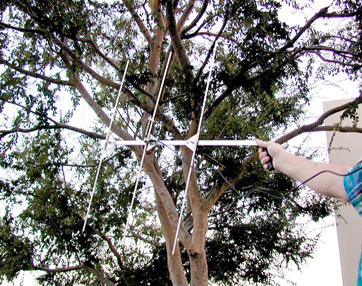
I should preface this story with a tale of a friend of mine from college who was in the Idaho wilderness tracking rattlesnakes tagged with radio transmitters. He was using a Yagi antenna, the most common of which look something like the picture on the right, made up of three thin metal "elements" or crossbars. Now, this fellow was rather enthusiastic about his work, and I can imagine him frolicking down a rock-strewn hillside searching for one of his snakes, not paying as much attention to his footing as he should. And sure enough, he tripped and fell and landed right on that Yagi. One of the elements evidently slipped over his eyeball and poked right through his orbital bone into his brain. Sounds icky, I know. Luckily, however, he was able to get back to the ranch and catch the next plane to Boise to go to the hospital, and got out the next day with just some swelling, headaches, and a forced vacation.

So, we've established one of the dangers of radio telemetry. The other one is perhaps more obvious:

When one works outside, one may occasionally get caught in a thunderstorm. And when this happens, one does not want to be holding up a metal antenna.

In 2011, I returned to the Black Hills for a different project involving woodpeckers, this time with Black-backed woodpeckers (abbreviated BBWO for all you bird nerds). It was an entirely different project with an entirely different supervisor,  but oddly enough, many of the study areas were the same. Thus, I frequently found myself returning to Wind Cave National Park to the very area where I almost ran into a sleeping bison and got almost eaten by a mountain lion (or so I thought) in 2005.

If you recall that last reference, one of the things that freaked me out on that trip was the looming threat of a thunderstorm. You really don't want to mess with thunderstorms out there, because there are few places to hide and generally we're carrying lots of expensive field equipment (GPS units and digital telemetry receivers, to name a few). But in that particular instance the storm dissipated before it got to me. That happens a lot with the summer monsoons.

In 2011, I parked at the Wind Cave campground to track a male woodpecker for a foraging observation. I didn't take a GPS waypoint at my truck, since I knew the area pretty well and it really wasn't that big a place. It would be nearly impossible to get lost. Plus I pride myself in my excellent inner compass, something which has come in handy many a time.

a male BBWO 
Our main job was just to locate the birds with the telemetry (they had backpack transmitters fitted over their wings, and I used a Yagi atenna just like the one pictured), make sure we had the right bird by identifying their uniquely-colored leg bands, and then put a piece of tape around the tree we found them on, so we could come back later and do vegetation studies. The point was to learn more about what habitat characteristics the birds were selecting. But occasionally we did foraging observations as well on a random bird each week, where we set a timer and watched the bird for 10 minutes, marking down how many times it drilled into the tree, how many beetle larvae it was able to get, and how much time was spent doing nothing or moving around. Every time the bird flew, however, we had to stop the time and go find it again, then resume the time-keeping until the ten minutes was up or it flew away again. Sometimes it was easy and the bird stayed in the same tree for the entire time, or flitted to a neighboring tree, and other times they didn't like us following them and kept zooming from tree to tree to tree.

On this particular day, that's what the bird did. It started out not too far from the campground, and so I didn't take any food or water or other supplies, just my binoculars, GPS unit, and telemetry equipment. Soon, though, the short hike began to turn into a merry chase. What was supposed to be a ten-minute observation started taking upwards of an hour. I had seen when I first set out that a rather ominous-looking thunderstorm was looming close to the west, but typically these storms moved south and I didn't expect it to hit me. I also remembered all those times the storm threatened but never actually hit, and I was bound and determined to finish this bird's fricking observation. It had gotten personal. That damn bird was NOT going to thwart me.

It did anyway. I had to call it quits after getting only eight or nine minutes of observation, as the thunder was cracking louder and big fat raindrops were beginning to fall. You can hear the lightning through the telemetry receiver, too, which is really freaky - you might not see the flash or hear the thunder right away, but the receiver picks up the electricity and sends out a loud and startling burst of static. Anyway, I thought I knew where I was, maybe a mile as the crow flies from where I had parked my truck at the Wind Cave campground. By this time I knew that the storm was going to hit - there was no doubt about it anymore - but I hoped that, if I hurried, I might make it back to the truck before it got really bad.

It's really difficult to explain the topography there, even with the help of a map. But the land was folded in lots of little ridges that went every which way from a broader plateau, eventually leveling out into the flatter plains of the park where the grasses waved and the bison roamed in their huge herds. I had followed the woodpecker up one of the northern ridges and continued climbing more gradually with the lay of the land, eventually getting to what was probably the highest elevation in that part of the park. It had been a zig-zagging path as I had been following the bird, but when I turned to leave, I thought I might be able to cut straight diagonally, gradually heading downhill before the last ridge dumped me off at the campground.


Of course, it didn't go to plan. As I said, I pride myself in my excellent inner compass, but I'm sure many people can relate to the notion that when you're focusing on something else while driving or hiking, you don't pay as much attention to your surroundings as you maybe should; and I was pretty focused on finding and watching that woodpecker. And parallel ridges are perhaps the most confusing and most irritating topographic feature to ever thwart my sense of direction. I went up and down, up and down among the higher parts of the undulating ridges, each one taking me lower and lower, until I was expecting to see the border fence and the concrete of the campground road from each successive ridgetop. But they never came.

I thought I had been going northeast, but the ridges I was following, further away than the ones I THOUGHT I was following, were sending me directly east. I didn't quite realize it until I saw the dirt road in front of me, which went nowhere, and which I knew I shouldn't be seeing. I had gone down so low in elevation that I now had to go up and over three substantial-sized hills in order to get back where I wanted to go, or else continue east through the grassland to the main road - which would have put me right out in the open in the coming storm.

Of course, about this time, the thunderstorm was really starting to get ferocious. Lightning was flashing alarmingly close, the thunder booming through my bones, the rain dumping down in torrents. I sprinted down the pointless gravel road a ways, but hesitated when it went out into the open. I cut back and tried to follow the edge of the trees, but the hills were steeper here, and I really didn't want to get any higher.

Eventually I gave up. I disconnected the antenna from the receiver and chucked it as far away from me as I could, then went to the lowest spot I could see, sat down in the wet grass, stuck my head between my knees, and tried to shelter my GPS unit and expensive telemetry receiver underneath my sopping t-shirt. I must have sat there for ten minutes, getting utterly and completely soaked, having no idea when the storm was going to end or if the next bolt of lightning would fry me.

Sooner or later, when I judged the worst of the storm was over, I picked up the antenna again and ran as fast as I could back toward the campground (taking care not to hold the antenna in front of me in case I fell, so as not to poke myself in the brain). It was still raining, still thundering, pools of water sloshing ickily in my shoes, my breath ragged, my heart racing. I kept hoping that maybe if I kept moving the lightning couldn't strike me.

Luckily, it didn't, and I made it back to the truck, a soggy mess. My equipment survived and so did I. I sat in the truck for a little while until the storm passed, then spent a good twenty minutes wringing out my clothes and changing into the spare pair of socks I always kept in the truck, driving without boots the hour back to the bunkhouse in Custer State Park.

Sort of funny, really; my previous post, where I freaked myself out into experiencing one of the scariest days of my life in field work, ended up being in almost the exact same spot where, six years later, I experienced another of my scariest moments.

So - lightning, sharp-toothed predators, trips and falls and pepper spray, and regularly (though unwillingly) taking part in what causes 66% of wildlife biologist deaths, sometimes I really wonder how this is going to end.


*Click here to read a story about Eric York, a biologist with whom I worked trapping coyotes in California, who died in 2008 from contracting pneumonic plague during a mountain lion necropsy.


Tuesday, September 24, 2013

Mistakes - My Own Worst Enemy

One day, I almost thought I got almost eaten by a maybe mountain lion.

I've said before that I've never felt in danger of life or limb due to a wild animal, but I suppose that's not strictly true. I did get awfully close to that grizzly bear sow the day the yellow telemetry plane saved us. And I got growled at by a captive wolf once when I was sitting next to him. That was freaky.

But there was a day in South Dakota that I was almost certain I was going to be eaten by a mountain lion. Why? Did I see this mountain lion? Did I stumble upon a fresh kill site? Did I hear his fearsome scream echoing through the hills?

Nope.

It was during the 2005 season working with woodpeckers in the Black Hills. Back then - and, I believe, this is still the case - mountain lions lived in the area in extremely high densities, owing to the large populations of deer and elk and the complete absence of any other predators. I never saw one. One day, however, my coworker Halle and I stumbled upon a fresh kill site.

I had never seen a lion kill site before, and I was just a sophomore in college with very little experience around these things, but it was pretty clear what it was. It was a mule deer buck, dead in the forest just outside the border fence in Wind Cave National Park, no wounds of any kind, but the fur had been plucked off of it and lay in a little furry carpet around the carcass. It was so fresh it didn't even smell. (Lions often kill their prey with a single bite to sever the spinal cord. Pretty clean.)

Now, if I'd have known anything about mountain lions at that time, I'd have gotten the heck out of there. But even though we kind of guessed what had happened, our position there beside it didn't strike me as particularly precarious. After all, we hadn't seen a mountain lion there, so it must be gone, right? So Halle and I casually finished what we were doing and headed back. Now that I know better, I'd guess that that lion was hiding just yards away, watching us, wondering what to do about us.

Anyway, a few weeks later, late one afternoon when the temperature was high and big storm clouds were beginning to creep into the Black Hills, Halle and I were faced with a predicament.

We had this one woodpecker nest we had to check which was an absolute pain in the neck to get to. There were two ways we could access the site - from the west, or the Old Shirttail Road, or from the east, where the Wind Cave National Park campground road cut into the hills. The roads didn't connect, and it took about 40 minutes to drive all the way from Wind Cave to the opposite end of the Shirttail Road, even though the roads themselves were probably less than half a mile from each other as the crow flies. The nest was about halfway between them.

The reason the nest was so horrible was because it was surrounded by a large thicket of mountain mahogany, a poky shrub that ripped our clothes and contained millions of strange bug things that got all over us when we bushwhacked through. It was also on the top of a steep ridge. Between hiking with our heavy extendable camera + battery (which together weighed probably 50 pounds) up the hills and through the horrible shrubs, in the heat of the afternoon, it was pretty miserable.

On this particular day, the Horrible Nest was the only one left to check. It was getting late, toward quitting time, and with the heat and the storm coming we were ready to call it a day. Halle and I were already on the east side, off Shirttail Road, but if we hiked to the nest and then hiked back, then had to drive all the way back to the Park (where we lived), it would take forever; but if we drove to the campsite and hiked in from there, it would be a harder hike and we might not get there before the storm arrived. Thus, I decided that I would hike to the nest alone, while Halle would drive out and pick me up at the campsite at the other end.

She departed, and I was left with just the extendable camera and battery - no water, no food, nothing. I didn't have a GPS unit, either. We knew the locations of each nest pretty well by now, and we scarcely ever had to use the GPS. However, normally we didn't approach the Horrible Nest from this direction, though I was confident I could find it.

There was a deep gully separating the road from the ridge the nest was on. There were several ridges that ran parallel here, but I knew which one I wanted, so I aimed for it. I had to beat through a dense thicket of shrubs and oaks in the gully, then face the blazing sun as I hiked up the ridge opposite. To my delight, there was not a mountain mahogany bush to be seen. Hey, I thought,  maybe this is the way to go from now on! By the time I got to the top I was already sweating and exhausted, and it didn't take me longer than a few seconds to get my bearings and realize my mistake:

I was on the wrong ridge.

By now I could hear thunder rumbling. Sweat was pouring into my eyes as I headed down the other side, certain now that the Horrible Nest was on the next ridge over. All the while I had the heavy extendable camera draped across my shoulders and the even heavier battery cinched around my waist, no water to drink, no GPS unit, nothing. I hoped and prayed that I was right about the Nest, because if it wasn't there, then I really had no idea where I was. And no sooner had I begun hiking up again than I found myself, much to my dismay, swimming in another sea of mountain mahogany. There was just no escaping it.

Half an hour had maybe passed since I'd left Halle on Shirttail Road. I was exhausted and hot and worried about the storm which, although it would certainly cool me off, would probably ruin the thousands of dollars-worth of equipment I was carrying. And then, just when I thought I couldn't get anymore panicked, the memory of the mountain lion kill popped into my head. It had been right in this area somewhere.

This country is crawling with lions, I thought, and here I am, alone, weak, tired...easy pickings.

I could imagine a great big tom staring at me through the bushes, calculating where on my neck to aim his canines, wondering what to do about the strange big tube-thing sitting on my shoulders.

Perhaps it was that new-found worry that sparked me to make my legs most faster, but eventually I made it to the top of the ridge and found the Horrible Nest there waiting for me, the pink flagging tape blowing in the wind. In addition to its horrible location the Horrible Nest was also horrible to check; some malevolent Northern flicker had chosen a cavity high up on a dead tree that was leaning 45-degrees forward into the next gully, and it took a great deal of coordination and patience to get the camera into the hole, then a great deal more coordination and patience to fiddle with it to where it was actually looking down at the eggs. You basically had to lean the camera pole back 45-degrees - on a 45-degree slope - and bear all its weight while manipulating the camera. Since I was already frustrated and tired and nearly done in with nervous exertion, I found this additional fight almost too much to bear, especially without Halle there to help. The thunder was rumbling. I had to get out of there.

So for all that effort, I didn't even get a proper view of the nest.

As fast as I could I lowered the camera and slung it over my shoulders again and headed down the ridge toward Wind Cave. Once again I had to bushwhack through the grove of mountain mahogany, dip under the barbed-wire fence, and keep an eye open for grumpy bison sleeping in the shadows, all the while expecting a lion to pounce on my shoulders at any time. Eventually I made it out and set my feet on the pavement of the campground road.

Exhausted, I walked over to one of the restrooms, set down my burden, and swallowed as much water from the drinking fountain as I could stomach. I was drenched in sweat, filthy, covered in little mountain mahogany bugs, and my hair was a rat's nest of twigs and dirt and leaves. As soon as I finished my drink and sat down against the building, Halle arrived. It turned out, she had been worried too about my excursion alone - we weren't supposed to ever go hiking alone, for our safety - and had driven like the devil back to the park.

No sooner had I told her about my journey than our boss, Dale, also pulled into the campground. I forget why he was there, but it was an odd thing for us to run into him in the field - usually he was out by himself far away doing point counts. I cursed our luck. I knew he would scold me if he found out what we had done. So we lied. Somehow, he believed our story that both of us had just finished hiking in to the Horrible Nest, even though while I looked like an absolute mess, Halle was still clean and sweat-free. He turned around and headed back home.

In the end, the storm didn't even hit, but dissipated before it got to Wind Cave. I never saw a lion but I was convinced they had been all around me, waiting for their moment to kill me, when, in all likelihood, the only thing I was ever in danger of was getting lost or dehydrated. And my panic made the real danger greater.

I really freaked myself out. To this day I think it's the most afraid I've ever been in the field. If I hadn't panicked so much, I would have checked the nest properly, wouldn't have worked myself up nearly to the point of collapse, wouldn't have put myself in the amount of real danger that I had. And really, I should never have broken the rules in the first place.

Sometimes, you're your own worst enemy.


Friday, August 30, 2013

Let this be a warnin' to ya

Lots of days, I did stupid things.

I feel like no blog about wildlife field research would be complete without some injury stories.

I also feel like nearly every time I've gone to work one of these jobs, particularly the ones with more ferocious-type beasts, my mom and dad bite their lips, try to still their quaking hearts, and spend the next few months expecting the phone to ring at any moment with the news that I was eaten by something with sharp teeth.

But in reality, I don't think I have ever been in fear for life or limb because of an animal.

A prelude: when I started the mountain lion job, I remember asking my boss Kevin how dangerous he felt the job was (after all, we were hiking - ALONE - to lion kills). He assured me that the likelihood of my being attacked by a lion was extremely low, provided I took the same reasonable precautions anybody should take when hiking in the woods in Carnivore Country. No, he said, no, you're more likely to be injured by falling down the crazy steep hills that abound along the Front Range. This I made sure to do, at least once. There's really no way to describe the feeling of suddenly losing your feet, finding them above your head the very next second, and then slamming your hips/butt into the rocks, then thanking your lucky stars that you stopped there and didn't continue rolling.

Well, I suppose I have three main stories about being injured in the field. I'm going to go in order of least exciting to most exciting, so skip to number three if you are desperate to be entertained.

1. Don't be a cheapskate. BUY BOOTS. 

My very first field research job was studying woodpeckers in South Dakota in the summer of 2005, in Custer State Park and Wind Cave National Park. I won't go into terribly much detail, but basically what my one coworker and I did was locate woodpecker nests by birdwatching (what a way to make a paycheck, eh?), then returning to each nest twice a week with an extendable camera to check on the eggs/chicks. We would record the number of eggs, the day they hatched, and the day they fledged (and how many made it that far).

Anyway, since this was my first field job, I really had no concept of the importance of proper footwear. And boots are expensive. And I was a poor college student. So I stubbornly refused to buy them, trekking out in the Black Hills with tennis shoes. This worked out well...for about a week.

One particular study area in Custer State Park looked like a Martian landscape, with flat, smooth, overlapping red rocks stacked haphazardly on top of each other, occasionally (and unexpectedly) loose in places, and pocked with rounded holes (aerial photo on the right). Also, since we were studying woodpeckers, and woodpeckers like dead trees, we were continually dodging deadfall with every step, adding to the difficulty. Oh, and they also were a favorite hangout of rattlesnakes. I had several near misses hiking around in that area.

One day, we were searching for a nest located somewhere in this area, and it was turning out to be difficult because the landscape looked pretty much identical everywhere you turned, and a single little pink ribbon marking the correct tree can be incredibly difficult to find. GPS units could only get you so far, but a lot of the time we'd get close and have to turn in circles looking for the spot. I was walking confidently, looking around as I went, trying to keep track of where I was placing my feet, when all of a sudden I just went down.

This was how it looked a week or so later.
I'm not sure exactly what happened; I must have slipped off the edge of one of the rocks, and twisted my ankle very, very badly; it was certainly the worst I've ever hurt my ankle, to this day. Luckily, it was the end of the day, and the end of the week, so I had the entire weekend to nurse it. I never went to see a doctor (PhD students are not typically the sort who want to deal with worker's comp forms, and our supervisor convinced me my ankle would get better on my own). However, in a relatively short amount of time I could walk pretty freely on it again, so I guess I lucked out.

I bought some boots the next day.


2. Don't be lazy. WEAR THE FREAKING BOOTS.

So, now I have boots, and I've always had a pair of boots for every field job ever after. However, I still don't particularly like to wear them when I don't have to, and this usually means I ride around with them in the truck and don't put them on until I need to do some hiking.

My current coworkers especially make fun of me for this. I don't honestly understand how people can wear those tight, hot, sweaty boots all day if they don't need to. I love the quote from "A Far Off Place", one of my favorite books: "Hadn't it been wonderful to recover the freedom of one's own feet after years of imprisonment in boots and shoes?" I suppose it could be a byproduct of my upbringing in the Arizona desert, where the weather really never gets bad enough to warrant closed-toed shoes of any kind. At any given time during my childhood I probably had 5 pairs of sandals/flip-flops, a couple pairs of dressy shoes, and a pair of tennis shoes for gym class. My first pair of boots were the ones I bought in South Dakota (in the above story) - I was 21 years old. I grew up with free feet and now they will never tolerate being confined.

Anyway, I really got into the habit of working in my sandals on the Mexican wolf project, since most of the time we were just driving around, triangulating on the wolves from our trucks, rarely having to do much hiking. I could easily just hop out of the truck in my sandals, take a bearing, hop back in, and speed away to the next site.

In New Mexico, when we couldn't hear a wolf's signal, one of our favorite places to go was the Negrito Lookout Tower. It was no longer manned, so we could climb up to the top and, most of the time, depending
on where the wolf was, the added height was enough for us to hear a signal. However, the road to Negrito was awful. I had a 4x4 truck, but the boulders on either side - and in the middle - of the narrow, steep road were huge, and I feared for my vehicle's undercarriage. Therefore, most of the time I would stop the truck before I reached the worst parts, and just walk up the rest of the road to the tower. Happily, I could do this in my flip flops, because however bad the road was, it was still a road. No problem.

One day, as I was creeping along up toward Negrito, I pulled over to begin the trek, but I was feeling particularly lazy. The road kind of curved around in a big arc (see picture) before finally getting to the tower, but if I just cut straight uphill through the woods, I could get there much faster.

I looked at the woods. It was a nice ponderosa pine forest, nice and open and inviting as they almost always are. Clearly no need for me to put my boots on. So I grabbed my gear and set off in my flip flops.

I hadn't gotten far when an unbelievable pain shot through the ball of my foot.

I had stepped on something that went right through my shoe and deep through the skin. I searched and searched on the ground around me and couldn't find anything that looked like it could be the culprit. But man, I was out for the count. The pain was even worse than spraining my ankle. There was hardly any blood, hardly even a puncture in my puny flip flop, but something had definitely done some damage.

I debated telling my boss. He didn't like me as it was, and, of course, there was the dreaded paperwork. I suffered in silence for a few days and then finally told him what happened. He frowned at me and told me what an idiot I was (because it was true), but he did say I could go to Show Low to get it looked at if I wanted to. But my stubbornness kicked in. He already hated me, and I would not give him reason to hate me more. Stupid. Yes.

Whatever happened - whether I actually fractured a bone in the bottom of my foot, or just got a really bad stone bruise - it took ages for it to heal. Months later, when I was in grad school, it would still ache occasionally.

I'd like to say I learned my lesson, but I suppose it's debatable. I still drive around with my boots in the truck, wearing my flip flops. However, I certainly put the boots on now whenever I go hike, even for just a short distance.

3. Bear spray. It works (on humans, at least).

This is one of my favorite stories to tell because a) there's a good lesson in it, b) people like to laugh at other people's pain, and c) for once, this time the injury wasn't entirely my fault.

Back to the mountain lion project, 2010...

bear spray
Whenever I went out hiking by myself, I typically carried a canister of bear spray in case I came face-to-face with a scavenging black bear at an old mountain lion kill, or a mountain lion itself. (We also carried bear spray all the time, even when hiking in groups, in Yellowstone because of the number of grizzlies there. I highly recommend doing this, and would not even consider hiking alone in Yellowstone, Glacier, or any other part of Bear Country without bear spray.) Bear spray is basically the same stuff in the typical can of mace on your keychain, just more of it, and stronger. I believe it has been proven very effective on bears, but nobody really knew what it would do to mountain lions. Still, I was too lazy to get my Concealed Carry license, and too cheap to buy a gun, so the free bear spray the Division of Wildlife let me use was going to have to do.

I usually had two backpacks with me every day, a small one just big enough for a bottle of water, some data sheets, and my Spot Unit (an emergency location device), and a bigger one that I put all my daily junk in and used whenever I had to go a greater distance and carry more food and water. As I said, I usually carried the bear spray whenever I was out alone. However, I sometimes didn't take it when I was doing shorter hikes, only a half mile or so away from the truck, because it didn't fit well in my small backpack. Also, when I was with another coworker, I wouldn't bother with it, since the odds were greater that an animal would hear us coming and leave, or be more hesitant to attack. Thus, much of the time my canister of bear spray got left in the truck.

One day, my coworker Kirstie and I were going to check out some data points in a canyon on some Open Space (public) land, just off of Flagstaff Road above Boulder. The road was too
rough for the truck, but we had brought along our ATV. We unloaded it and sped off down the road. I only took a small bag with my water and some other supplies, leaving my larger backpack - and can of bear spray - in the backseat of the truck. We collected the data, turned around, and came back to the truck within the span of about an hour.

When we got back, we loaded up the ATV, and then Kirstie and I prepared to head back to Fort Collins. I opened the little side-door behind the driver's seat, threw my little backpack on top of my bigger backpack, and instantly got a face-full of mace.

Evidently the safety had come off the canister. And the nozzle was pointed directly at me. When my little backpack hit it, it fired off a pretty good dose, directly into my right eye.

Nothing can describe the agony. You'd have to experience it yourself to know how it feels. I doubled over and clasped my hands to my face. Kirstie instantly knew what happened; she had been standing on the other side of the truck, putting things in the passenger seat, in the fresh air, away from the direction of the spray, and yet the instant it went off, she started coughing. That stuff is potent. She rushed over to me and handed me a Camelbak, and I lifted my head and rinsed my eye as best I could.

I was probably spared some pain by my contact lens absorbing some of the blast. I peeled it off and threw it on the dirt. After a couple of minutes, the pain in my eye subsided somewhat, and Kirstie and I decided to get back to Fort Collins as soon as possible. On the drive, I called the Poison Control Center to see if I needed medical attention. Luckily, they assured me I didn't; the stuff was just intended to be an irritant, not to cause serious chemical burns.

The stinging in my eye didn't last very long...but wasn't the only effect. It got all over my skin, too, on my face and some on my right arm. For days, I felt like I had gotten a horrible sunburn, my skin hot and tender to the touch. And my poor truck... for about a week afterward nobody could get into it without coughing, until the residue finally went away.

So, if you ever doubt the usefulness of bear spray, I can assure you that it works. I can't imagine any bear - or mountain lion - getting sprayed with that stuff and not being completely discombobulated, at least for a few minutes; enough time, anyway, for you to get away. And if you don't have any other weapon, it's certainly a great thing to have.

But the main lesson of the story: when not in use, always make sure the safety's on.

I have a canister of my own bear spray now, and you can bet I'm extremely careful with it.

(In recommending bear spray, I feel the need to emphasize that anyone who uses it needs to be aware of several things: they do expire and they do need to be tested periodically.)


Thursday, August 29, 2013

Babe


Meet Babe.


I did not take these pictures. Back in 2007, pretty much anyone who came to Upper Newport Bay in Orange County, CA, could see and photograph Babe whenever they felt like it. She was extremely visible, often parading her newest litter of kittens out in front of joggers and motorists in the middle of the day, not at all afraid of the crowds of humans who visited the popular area.

Unfortunately, I don't have any pictures of Babe's kittens, and it appears the ocphotosite.com website no longer exists. As of 2010, she was apparently still alive (Click here for a little news story and photo.). But when I worked with her, it was back in 2007-2008.

I worked for the US Geological Survey for about a year studying the movement of bobcats and coyotes through urban corridors. It was a really interesting study. We drove around Newport Beach, Irvine, Tustin, Laguna Beach, Laguna Woods, Costa Mesa, Lake Forest, and Aliso Viejo monitoring the cats with telemetry, regularly checking a few dozen remote cameras we had set throughout the area, and trying to get more collars out on the animals. The main purpose of the study was to learn more about what the animals needed in a corridor, so that when the Orange County Great Park, which was in the process of being built on the old El Toro Marine Base, was completed, it could facilitate the movement of individuals between the Cleveland National Forest in the east and the San Joaquin Hills along the coast. (Interesting note: Will Smith's character was based out of the El Toro Marine Base in the movie Independence Day.)

Babe was already a pretty well-known cat before she was captured, which happened a few weeks before I got on the project. The capture crew had initially wanted to call her Tamale*, because she began to overheat while they were working her up. This happens occasionally, and they doused her with water and put alcohol on her ears to help her cool off. Eventually, though, they decided to call her Babe, after her habit of cruising Upper Newport Bay.

Unlike the collars we used on the mountain lions in Colorado, the bobcats had GPS collars that collected data points every few hours but could NOT be remotely downloaded. The data was stored on the collar, and when the collar's battery got low, it was programmed to automatically drop off the animal, and emit a different signal to let us know. Then we could walk in and retrieve the collar, plug it in, and get all the GPS data off of it.

Unfortunately, many of our collars failed. Often the drop-off mechanism would fail, the battery would die, and we would lose all ability to find the bobcat, relying then on spotting the cats on remote cameras and trying to recapture them to manually remove the collars. Thus, whenever we detected the drop-off signal, we weren't always 100% sure that the collar was actually no longer on the animal.

One day, Babe's collar started emitting that drop-off signal. Upper Newport Bay itself is a nature preserve, but it is surrounded by very densely populated neighborhoods and a handful of ritzy golf courses. Now Babe had been on her own for a while, having booted off her last litter of kittens, and had kind of disappeared out of her normal area for the previous few weeks. We actually feared she had gotten killed on the road somewhere. When Robert finally did pick up her signal, it was a few miles away from UNB in the heart of one of the neighborhoods. A day or so later, it started to give the drop-off signal.


So Robert set off to find it, eventually pinpointing it in someone's backyard. Robert knew there was the possibility that Babe was still wearing it, so he gave her a few days before walking in to retrieve it. When he returned, the signal was still there, so he got permission from the homeowner and walked into the backyard to get it. The backyard was small, lined by a row of hedges planted in a raised bed that backed up against the stone fence behind it. Robert crawled back behind the stickly, poky hedge with difficulty, came around a corner, and came face to face with Babe herself. 

She didn't act aggressive at all, but Robert immediately got out of there and told us the news. We easily figured she had had her kittens back there. It was quite a protected spot, out of reach of any coyotes or other bobcats that could kill her kittens, and sheltered from the elements. Our best guess was that the collar just happened to drop off there shortly after she gave birth, and her kittens were probably snuggling with it. We decided to give her a few weeks to get out of the area before trying to get the collar. Now, of course, we had absolutely no way of knowing where she was at any given time. 

And so, when the few weeks were up, they sent me in to try to get the collar. 

Robert and one of our supervisors, Lisa, came along. This time it was my turn to poke my head through the hedge. I dove in at the corner and cruised against the stone wall where the foliage was thinnest. When I reached the spot, I stared hard, trying to see through the darkness of the thick greenery. At first, I thought I could see a divot in the dirt, and eagerly moved closer to try to find the collar. But as my eyes adjusted, the dark form in front of me changed, morphed, took a different shape, until I could perceive the barely visible twinkle of a cat's eye against a dark bobcat-shaped head, tufted ears and all. She was still there. 

Again, she didn't react. I could have gotten a face-full of bobcat claws, since I was probably only about five or six feet away from her. I think she understood by now, after her years of frequenting the Bay, that we humans weren't likely to hurt her or her kittens, and bobcats, unlike canids, typically crouch and take cover when threatened rather than run for it. But needless to say, I got the heck out of there. 

 Eventually we were able to retrieve the collar, and Babe came back to Upper Newport Bay with a new set of kittens trailing behind her. She no longer had her necklace, just colorful earrings that she would have for the rest of her life. 

I don't actually know where Babe is now, if she's still alive, what happened to her, etc. Odds are, she got hit by a car, because that seems to be the fate of pretty much every urban bobcat in southern California. But she was one of our greatest tools in educating the southern California public about carnivores, letting them see the untamed beauty first-hand, and teaching them that bobcats can live alongside humans peacefully with no need for fear, as long as we maintain the appropriate distance and respect.

Regarding the bigger project, we ended up getting some interesting data from our cats. We found that in the more densely human-populated areas, somewhat removed from big expanses of habitat like Upper Newport Bay, the Laguna Coast Wilderness, and Crystal Cove, the bobcats were using whatever they could find to move around and build their territory. Two of our cats, named Homer and Sloane (both cats I got to help capture - Homer was my first), were caught right at the junction of the I-5 and I-405 freeways behind a Carmax Superstore. Both had almost completely linear home ranges along the riparian strip that wove between office complexes and neighborhoods. I don't know the status of the Orange County Great Park project, but I hope it's able to connect the east and west habitats, allowing more gene flow among the bobcats to help them maintain their populations in Orange County....because in this world of increasing distance between Man and Nature, the bobcats were the perfect ambassadors.

P.S. If you're interested in that kind of thing, you can find the final report of our project at the following link: Click here! Toward the end, in the appendices, are a bunch of really cool camera-trap photos, including some taken when a wildfire swept over our Cuddeback cameras without damaging them.


*Now that I have spent four months in Mexico, I feel the need to emphasize that the singular of "tamales" should be "tamal", not "tamale". That bugged our Spanish teachers to no end while we were in language class.

Sunday, August 25, 2013

In the Lion's Den

One day, I found some mountain lion kittens.

By far, my favorite moments working in the field of wildlife biology have been, and will always be, when I get to see wildlife out doing its thing. When one works primarily with carnivores, this is not a frequent occurrence.

During my time on the mountain lion job in Colorado, I was lucky enough to get a few glimpses of some of our collared cats, as well as an older kitten when I accidentally stumbled upon it (see the post "Here, Kitty"). But what I really wanted was to see kittens in a den. My boss and a tech who was only working part-time for us - which only added insult to injury - had found a den earlier in the season, and I had searched a few likely spots since then but come up empty. 

We usually only checked the den sites to confirm whether or not one of our female cats had had kittens. We weren't cleared to handle them at all - you need special permission from Animal Care and Use committees to do that, apparently. We also had very narrow windows during which to search, as we had to wait until Mama was off hunting, since the last thing we wanted was to stumble upon a very defensive mother mountain lion. The few times I did den searches, we either missed the kittens, or the mother had already moved them. 

I say "miss the kittens" because if you've ever seen a mountain lion den site, you'll understand why it can be so hard to find them. Of the four I had seen, two were located in extremely dense scrub oak thickets, and the other two were in boulder fields. Scrub oak is a species of oak that is short, tough as nails, and grows really close together in enormous groups. You basically have to crawl on your hands and knees underneath the snagging branches to get through it, twisting through it like a labyrinth. Scrub oak destroyed my favorite pair of field pants, for which I have not yet forgiven it. The boulder fields are almost equally annoying, as you have to hop from rock to rock, checking for protected spaces underneath them where a mother might stash kittens, all the while trying not to slip and fall and break your neck. 

As I've said in previous posts, we had GPS locations for all of our cats from their collars, taken every four hours and remotely downloaded; so den sites were usually easy to spot on the maps as an enormous jumble of GPS locations all concentrated in the same general area. But satellite fixes, at least with our technology, are not 100% accurate - depending on the location of the satellites, the position of the cat, the weather, the vegetation, etc., a cat can stay in the same spot for hours and we'll get a map of points sprawled out over maybe a fifty-square-foot area. The kittens could be anywhere in there.

Skunk kill from this cat
And now, I'd like to introduce another star cat, one of my favorites because of her interesting eating habits. She was apparently quite old, and the last time she'd been captured the crew had noticed that her canines were worn almost to stubs. She had had multiple litters of kittens but, to the knowledge of the team, none had ever survived - for some reason, she always abandoned her kittens shortly after giving birth to them. But the most interesting thing about her was the most common prey item I logged for her: skunks. Her data was always easy to collect because I just had to follow my nose, and more often than not it would lead me to a pile of black-and-white hair and little bones, with the occasional intact head or tail sitting amidst it all. Whether her inability to raise young, broken teeth, and taste for skunks were all tied in somehow, maybe to a brain injury or other deformity this cat had, we could never be certain. 

It became clear late in the winter that something was going on - whether she was injured or had kittens, we weren't sure. All we knew was that she was sticking around a particular area for a long, long time. It seemed an odd time for her to have had kittens, but then again Colorado lions don't seem to stick to a regular breeding schedule - they can have their kittens year-round. 

And so, one day, I was instructed to go with another technician to investigate. 

At first, it was an easy hike. The other tech and I - an older, seasoned guy who had worked with lions for decades - drove as far as we could over a rough two-track road, then walked the rest of the way, along a creek and around a gently-rising hill. It didn't take long, however, before the trail ended at a massive boulder field. Below, we could see enormous rocks littering the hillside, the area devoid of almost all vegetation except for a tiny oasis of scrubby trees and shrubs in the very middle of it. We had to backtrack and hike over some pretty sketchy stuff to get down into it. We clambered over the boulders as best we could, and all the while I checked the mother lion's telemetry to make sure she wasn't in the area; we were able to hear her signal, but it was very weak, clearly indicating that she was far across the valley below.

It took a long time but we finally reached the trees in the middle. We were in the middle of the big jumble of GPS points, most of which were concentrated, of course, around the boulder field. I balked at the task before us; it was going to take ages to search under the rocks. I briefly considered giving up. After all, the kittens were probably gone or dead, and I had learned from experience that trying to find these guys in this kind of situation was like - pardon the cliche - trying to find a needle in a haystack.

However, Nature itself, this time, came to my aid.

From startlingly nearby, I heard a shrill whistle. It sounded completely out of place in this barren, silent landscape. I thought maybe my coworker had made the noise, but when I looked at him, his eyes had gone wide. "Kittens!" he said.

"What?" I said. Surely mountain lion kittens didn't whistle.

But the whistling continued, and as I was closer, I scrambled over the enormous boulders, trying to pinpoint the source of the sound. When I stood atop a particularly gigantic rock, looking down at a little patch of soil separating it from its neighboring rocks, a slight movement caught my eye.

A mountain lion kitten, days old, crawled out from under the boulder, its ears and eyes still shut, its fur speckled with little black spots. In between its whistles, we could hear the whistling of a sibling, still concealed beneath the rock. The visible kitten groped blindly in the dirt for just a few seconds before heading back toward the safety of the den.

I couldn't believe my luck. I had finally seen a mountain lion kitten.

Click on the video below from the Cincinnati Zoo for some examples of the sound.


The whistling is the kittens' method of communicating with their mother, and I heard it later, from the Golden lion's kitten ("The Cat Came Back - Part II"). It's certainly not the sound you would expect to come from a cat. I was glad the little kittens had done it, though, or we probably never would have found them.

Unfortunately, the crazy mother did abandon them, as her behavior over the next few weeks didn't indicate she was still supporting kittens. And so, a little while later, I brought my boss Kevin to the site to see if we could find them.

We made the difficult journey back to the site, and I lowered myself down into the space between the boulders to dig around in the dirt. It didn't take long for me to find little bones and poofs of spotted kitten fur. Kevin even got down and crawled as deep into the den as he could go, which was pretty deep (see pictures).
See if you can find his shoes

So, it was kind of a sad story, as the kittens didn't make it; but these things happen, and I'm not sure I would have felt better if we had had ACUC permission to rescue the kittens and bring them back to Fort Collins. There, they would have grown up in a pen (if they survived at all), then probably been translocated out in the woods again to fend for themselves. Some lions can thrive in those circumstances, it's true. At the risk of sounding like a hypocrite, since I love seeing wildlife up close and getting the chance to touch and smell and hear the animals while processing them at capture, it's always best to interfere with these animals' lives as little as possible.

Nature can be harsh, yes. Mothers abandon their young for reasons we don't understand. Animals take the lives of other animals to survive. Even though I love carnivores, and I myself eat meat occasionally, whenever I'm watching a documentary of a wolf or a pride of lions chasing down its prey, I find myself rooting for the chased, the underdog, the victim. We find ourselves empathizing with creatures, allotting human rights and qualities to them, finding sadness in tragedies such as these. Some people think it's in our nature as humans to fear the wilderness and all its ferocity, its untamedness, its danger, to want to distance ourselves from this life-and-death struggle that goes on outside our cities.

But is our fear of wilderness in our nature? Or do we fear it because we have lost our nature?

Thursday, January 3, 2013

Chasing wolves with painball guns - Part 2

A few days later, I became Paintball Rambo.

The second adventure took place during my second tour at the Gila Cliff Dwellings National Monument. After several volunteers and staff had patrolled the park for several weeks, I was asked to return - actually, it was my last week of work before driving to Missouri to start grad school.

I reluctantly drove back, remembering the incredibly socially awkward fisheries scientists, and stopping by a store in Silver City to purchase a mattress pad for the back of the Ford Explorer. After my previous, extremely boring 4-hour-each-way drive with no radio, I had rigged up a handy system with my iPod, plugged into my iHome, plugged into a power converter, plugged into the cigarette lighter, so I could sing my head off and make the drive a bit less monotonous. It worked beautifully, except that the iHome wall transformer was huge and heavy and, if I stopped suddenly or hit a bump, the whole ensemble collapsed.

The first few days were uneventful, me continuing my nightly patrols and daily naps, stalking the screened-in porch during the days to enjoy the view of the Gila River and read one of the many books I'd brought with me. A woman who worked for Defenders of Wildlife, named Cynthia, had been in the area as well, talking with ranchers and campers and overall trying to, in whatever ways she could, change people's minds about wolves. Although I had mixed feelings about Defenders of Wildlife, this particular woman was extremely level-headed, drawing from a lifetime of experience living and working alongside ranchers, with a clear understanding of the challenges they faced and the reasons they disliked the wolves. She cruised around Gila Hot Springs and the National Monument doing her thing, while I cruised around doing mine, and occasionally our vehicles met and we rolled down the windows to chat for a few minutes. I kept her updated on what the wolves were doing - which, that week, was primarily staying off to the west and north of the Monument. I was counting down the days until I left for Missouri, just hoping the wolves would continue to behave themselves and make my job easier (though, admittedly, much less exciting).

The last night, however, things changed.

It was early in the evening, and as I started my patrol, I turned on my telemetry receiver and listened with surprise as both the wolves' signals came booming in.

I cruised westward toward the Monument, hopping out of the truck every few minutes to roughly triangulate their position. They were together, just north of the main road, probably on top of the first ridge. At the corral, I decided I was close enough that I could run up there with my paintball gun and chase them back northward. As quickly as I could, I grabbed the H-antenna, paintball gun, and an extra load of paintballs, locked the car, and sprinted up the scrubby hillside. I had a little waist pack that could hold the telemetry receiver, and I stuffed the pack of paintballs in it with my headlamp and car keys. The sun had set, but there was still plenty of light.

At the top of the hill, I listened to the signals, which still were booming in. Gain low. Signal strength high. They were here, somewhere, probably watching me, their rusty fur blending perfectly with the rocks and dirt in the dim light. I switched off the receiver and listened. All was silent.

Even though I couldn't see them, they were so close that I figured this would be the best location to fire at them. I strained to remember the exact radio conditions that previous time with James, when the figure of the male wolf had materialized through the fog not 50 yards from where I stood. I might even hit them, wherever they were. It would be better to fire now, make some noise, than try to sneak closer and let them slink off on their own terms.

So I slung the paintball gun to my shoulder and pulled the trigger.

Nothing.

The CO2 canister was empty.

Frustrated, I threw it across my back, took the receiver and antenna in my right hand, and started running north like a maniac, yelling as loud as I could in as low a voice as I could, trying to make myself sound as scary and intimidating as possible.

Once atop that first ridge, the ground sloped up and down in a more or less gentle undulation of continuous, low hills. The Middle Fork of the Gila River flowed parallel to my right - eastward - where it swept past the Visitors Center and joined the West Fork in a broad, sandy wash near the intersection of the roads. Here, where they met, the rivers had carved the hills I now ran on into steep cliffs between them, which gradually lowered the further they got from the confluence.

I continued chasing the wolves, pausing at the top of each little hill to check the telemetry. They kept moving northward, but also eastward, toward the Middle Fork north of the Visitors Center. I knew about the cliff, and knew I was approaching it, but since the signals were still so strong, I assumed the wolves were still up on top with me. However, after a few more minutes of jogging, I reached the brink and stared down, thirty feet above the broad bank sloping gently down to the water. The wolves were already in the valley.

I really didn't want them to go back south; south and east was Gila Hot Springs. There was no way I could get down from where I was, so I continued north, running a few paces from the edge, looking for a gully or some rocky stairs that would get me down, all the while monitoring the wolves' signals. To my dismay, as my H-antenna sought the radio signals, I found myself pointing southeast. They were headed right toward Gila Hot Springs and a smorgasbord of goats and sheep. The light was considerably dimmer now, the Visitors Center had long since closed, and I began to feel panic gripping the edges of my consciousness.

I urgently sought a way down and eventually found one, maybe five minutes after I'd reached the edge. I slunk and slid down the side and lurched through the shallow waters of the Middle Fork, running past the Visitors Center and hitting the pavement of the road. I imagined what an odd sight I must be - soggy boots, paintball gun in one hand and antenna in the other, running down the road as if all the hounds of hell were at my heels. By the time I crossed the bridge, the darkness was nearly complete, the sandy banks of the river a blue-gray shadow with the black water cutting through the middle.

When I reached the intersection with the main road, I checked the signals again and learned that the wolves hadn't crossed the road, but were heading toward the town along the northern ridge. Here, private property prevented me from following on foot, so I decided to fetch the truck. I jogged all the way and hopped in, throwing the paintball gun disdainfully on the floor, and sped back toward town as fast as I could.

I cruised the main road listening with the roof antenna, and soon learned that the wolves hadn't made it very far east yet. Their signals were relatively weak, bouncing in and out, suggesting to me that they were a ways uphill away from the road. I hoped that I had at least given them a scare and that they wouldn't try anything with the livestock tonight, and decided to monitor them every half hour. First, I had to make a phone call.

I headed back to the house of the awkward fisheries scientists and plugged my calling card numbers in. I reached my boss and told him that the wolves were now close to town, paraphrasing my adventure with the cliffs. He sounded unhappy, but also admitted that there was little I could do - since everything was private property, I could only monitor them and hope they didn't get into any trouble. I hung up the phone and headed back, parking my truck near the intersection of the main road and the road to the Visitor Center.

After a few minutes, a familiar truck pulled alongside me. Cynthia stepped out and walked to my open window. Before I could recount my tale, she trumped me with one of her own:

"Somebody spotted a mountain lion down there near the river this evening," she said. "Apparently it killed an elk and dragged it underneath the bridge, and is there right now eating it."

My heart jumped. I had been sprinting down that bridge like a lunatic not half an hour before. And all the while there'd been a mountain lion beneath my feet, eating an elk that it probably would have readily defended if it felt threatened.

I told her about the wolves, and she generously agreed to help me keep a lookout. Fortunately, the wolves never did get into trouble, at least not that night. It was a month or so later, when I was all settled in at graduate school, that I finally learned what became of the Laredo Pack.

One evening, the caretaker of a ranch saw the male wolf on his property. He reportedly mistook it for a feral German shepherd that was after his calves, shot it, and killed it. That could have been the end of it - Mexican wolves are all too frequently illegally shot, and there rarely is enough evidence to convict the perpetrator.

The wolf team noted his sudden absence and began searching for him from the airplane. Topography and, in this case, several feet of dirt or concrete, can hinder reception from the ground, but many times signals can still be detected aerially. The biologists quickly found themselves circling above a house in the vicinity of Gila Hot Springs and sent the USFWS Special Agent over to check things out. Apparently, the guy buried the carcass, or put it in his basement, or something - radio collar and all. Check out the news release here.

His mate high-tailed it, at least for a little while, and after that I'm not sure what happened to her. The ranch caretaker claimed to be a supporter of the reintroduction program, making an honest mistake about the identity of the animal threatening his employer's livestock.

I try not to make judgments about these things, even though they can be very emotionally charged. Heck, I fostered a lifetime fondness for the species, and then spent two weeks of my life staying up all night and sleeping in the back of a Ford Explorer trying to keep that wolf out of trouble, and he got shot anyway.

Maybe one day I'll write a post about my opinions on wolves, which, to say the least, have morphed greatly over time.